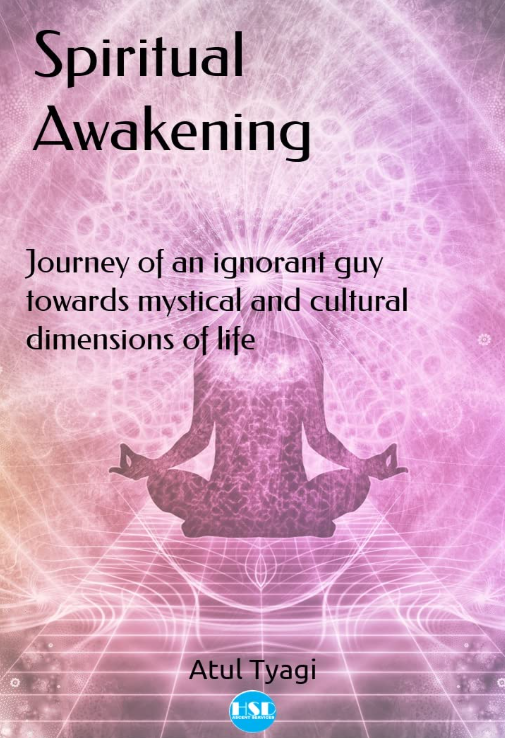
Spiritual Awakening: Journey of an Ignorant Guy Towards Mystical and Cultural Dimensions of Life is a reflective and intimate exploration of one person’s evolution from everyday ignorance to a deeper awareness of life’s subtler realities. Rather than presenting itself as a definitive how-to on spirituality, the book functions as a candid travelogue of inner transformation — one that many seekers may recognize in their own lives.
At just over 100 pages, Tyagi’s narrative is compact but rich with honest observation. The author frames his journey not as a spiritual expert, but as an “ignorant guy”, a term he uses to describe his early unawareness of the deeper forces shaping human perception and experience. This self-deprecating lens makes the book accessible; it doesn’t require prior study of esoteric traditions, nor does it overwhelm the reader with dense philosophy.
One of the book’s strengths lies in its grounded approach to mysticism and culture. Tyagi challenges simplistic dismissals of indigenous knowledge and so-called “pseudo-scientific” beliefs, re-evaluating them through the lens of lived experience rather than academic orthodoxy. He emphasizes that spirituality isn’t about following a prescribed path laid out by others, instead, it is about transcending the habitual limitations of our perception. This theme resonates throughout the narrative, encouraging readers to question what they take for granted about reality, identity, and meaning.
The writing style is personal and relatable, blending anecdote with introspective commentary. Rather than distancing the reader with jargon, Tyagi speaks directly, sometimes simply, sometimes poetically, about the tension between material concerns and what he calls the “universal law.” As a result, the book feels like a conversation with a thoughtful friend rather than a lecture from a guru.
However, readers seeking rigorous philosophical discourse or systematic spiritual methodology might find the book’s informal tone and exploratory structure less satisfying. The narrative doesn’t uncover definitive answers so much as offer reflections that invite further contemplation. For some, this open-ended quality will be a strength; for others, it might feel diffuse or underdeveloped.
Ultimately, Spiritual Awakening stands out as a genuine and humble account of personal growth. Its charm lies in Tyagi’s sincerity and willingness to share the vulnerabilities and insights of his journey; not as a finished product but as an evolving process. For anyone curious about spirituality from a reflective, everyday perspective, this book provides a meaningful starting point and many moments of recognition.