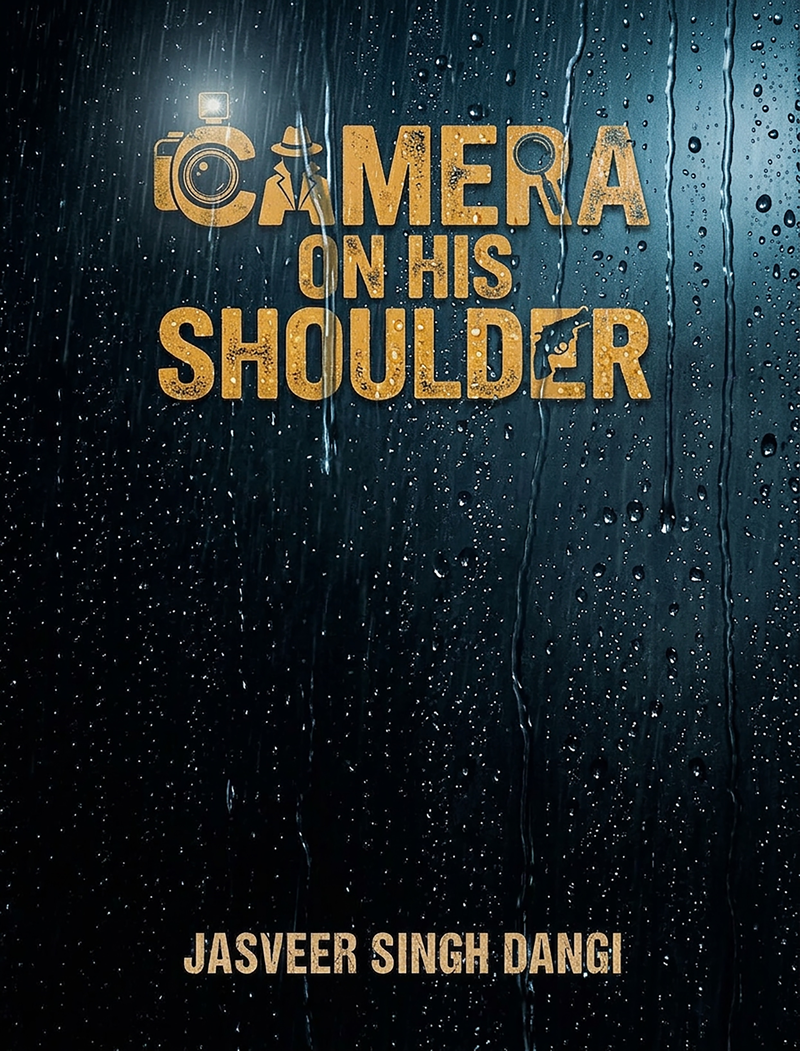
Review & Foreword by Mudit Singhal – Screenwriter & Director (Yes Sir)
When Jasveer first asked me to write the foreword for this book, my immediate reaction was: why me? I am no literary critic, no academician, no seasoned book reviewer who can claim the authority to introduce a novel with the kind of gravitas a foreword traditionally demands. I am a filmmaker. Words on a page (well at least the pages of a book), are not my usual currency. But then, Jasveer and I go back to the Covid years, I have read parts of his earlier work, and he has been a co-producer on one of my short films. There is a certain trust that builds in those kinds of collaborations. So I thought: why not? Consider this my debut as a foreword writer. You have been warned!
And then I noticed the dedication. To Satish Shah, and to Jaane Bhi Do Yaaron. If you know that film, and if you love Indian cinema, you must, you will understand instantly why that dedication alone made me lean forward. That iconic, chaotic, darkly comic masterpiece about two ordinary men stumbling into extraordinary corruption. Something in that dedication hinted at the spirit of what lay ahead in these pages. And I was not wrong. Because what Jasveer has built here is, at its heart, a love letter to a world that no longer exists: the India of the 1980s.
There is a particular kind of nostalgia that this book unlocks, one that our generation carries quietly within us. A world before screens took over everything. A world that ran entirely on the analog. Pat Shah does not google a suspect. He calls in favours from a switchboard supervisor to trace a trunk call. He decodes a Morse Coded message. He loves to listen to Best of Kishor Kumar on his most prized possession, a cassette player. A Philips Prestige radio hums in the background while clues are pieced together over tea. Personal diaries, not a hard drive or cloud backup, hold the key to unravelling an entire criminal empire.
And the world around Pat Shah is equally tactile and alive. The atmosphere on railway platforms, the clack of wheels, chai-wallahs shouting prices, families boarding in a blur of luggage and farewells, the smell of samosas and chana mingling with diesel. The dockyard at Bombay, with its stench of salt, fish, and rust. The trams of Calcutta. The clubs in Goa. The bungalows in Pune. A pink Cadillac Sixty-Two waiting outside a Bombay building. Nostalgia!
Songs drift through nearly every scene: Chura Liya Hai Tumne Jo Dil Ko, Kiska Rasta Dekhe, Raat Kali Ek Khwaab Mein Aayi crackling from a cassette or a radio, and they do not feel like decoration. They feel like atmosphere. Like memory. Reading this, I kept thinking of Sriram Raghavan, one of my favourite filmmakers, and how he constructs his noir worlds with exactly this kind of layered, sensory, period-precise detail, where the texture of a place is as important as the plot unfolding within it. Jasveer does something similar here, on the page.
At the centre of this world is Pat Shah, a private detective with a Scotland Yard background, a hip flask that never seems to run dry, nightmares he cannot name, and an instinct for closing in on the truth that is both his greatest strength and his most reckless quality. He is a compelling creation: world-weary but not cynical, battered but not broken. But I will confess, as fascinating as Pat Shah is, I found myself even more drawn to his partner, Camera.
Is Camera a camera? Is Camera alive? I will not spoil it for you. What I will say is that this particular relationship between a detective and this mysterious companion who watches, records, and in quiet, inexplicable ways protects is unlike anything I have encountered in Indian crime fiction before. Camera narrates this story. Camera feels things. The question of what exactly Camera is, is itself a mystery worth reading the entire novel to solve. And what kind of a name is Pat, anyway? The book never quite tells you. Or does it?
I should also admit: not once while reading did I not picture Satish Shah saahab as Pat Shah. Something about the dedication planted that image and it never left. Every scene, every moment where he lights a cigarette, every moment of quietness and conversation with Camera, I saw his face.
The mystery itself is a proper chess game spanning Bombay, Calcutta, Delhi, Madras, Pune, cities that remind us of the older era, and somewhere in between, there are smaller cities and towns like Gurgaon and Karjat, all with a purpose. It moves like a train that keeps picking up speed: false identities, shell companies, forged medical reports, smoke grenades, stolen manifests, Morse-coded authorisation signals, an island fort stocked with weapons and crates of explosives, a human-trafficking ring that stretches across continents. Pat Shah peels back layer after layer, and every time you think you know who the hunter and the hunted are, Jasveer quietly rearranges the board. It is a labyrinth and a deeply satisfying one to lose yourself in.
This is Jasveer’s fifteenth book. Fifteenth. I find that quietly astonishing. There is a discipline and a generosity in that, a writer who keeps returning to the page, keeps building worlds, keeps inviting readers in. I hope he keeps going. I hope there are many more Pat Shahs and many more Cameras ahead of us.
For now, welcome to 1980s India. Watch your step at the docks. And don’t trust anyone who doesn’t answer a simple question about their name.